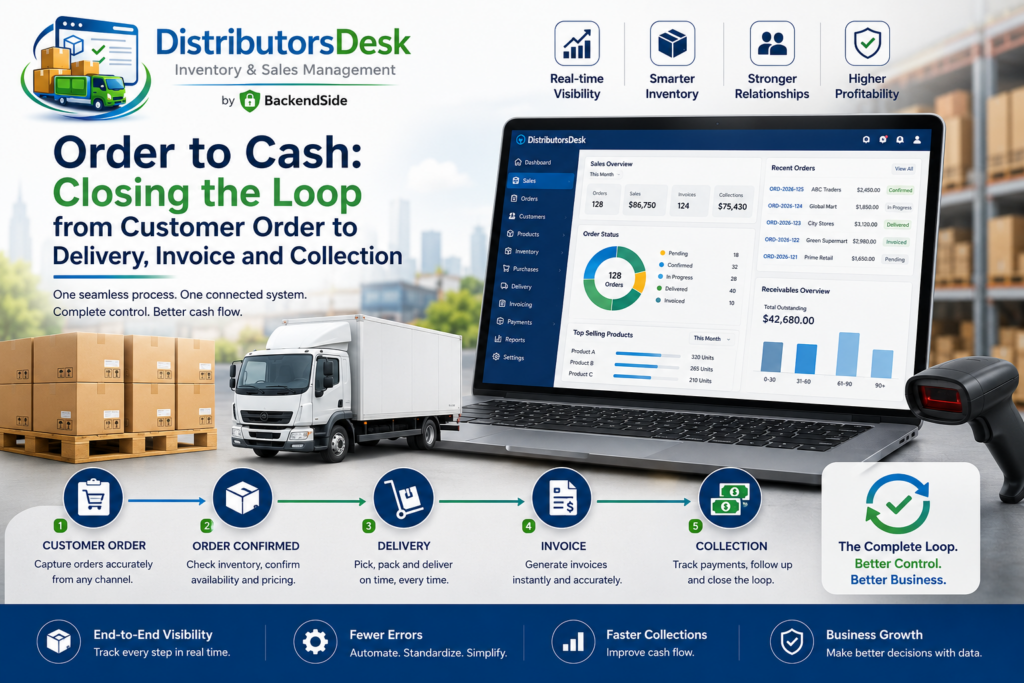
A distribution business is a chain of promises. A customer orders, the warehouse ships, the office invoices, and eventually someone pays. Every one of those handoffs is a place where the chain can break — goods delivered but never invoiced, an invoice raised for a quantity that was never sent, stock figures that stopped matching the shelves in March, a payment applied to the wrong account. The discipline that holds it together is called the order-to-cash cycle, and closing it end to end is the difference between a wholesaler that knows its position and one that finds out at year end.
The five stages of order to cash
Order to cash (often written O2C) covers everything from a customer’s intention to buy through to money in your bank. For a distributor it breaks into five stages, each producing a record the next one depends on:
- Order. The customer commits to specific products in specific quantities at specific prices.
- Delivery. The warehouse picks and dispatches — in full, or in part, which is where most of the difficulty lives.
- Invoice. A bill is raised for what was actually delivered, not what was originally ordered.
- Collection. Payments arrive, are matched against invoices, and outstanding balances update.
- Reconciliation. Stock, customer ledgers and revenue all reflect the same reality.
The critical word is linked. Any stage that starts from a fresh, re-keyed set of numbers rather than the record before it is a leak.
Where the cycle actually breaks
In practice, four failures account for most of the money that goes missing in small and mid-sized distribution.
Delivered but never invoiced
The classic. Goods leave the warehouse on a busy Friday, the delivery note goes into a pile, and the invoice never gets raised. Nobody notices because nothing is chasing it — the customer certainly is not going to ring up and ask. This is pure, unrecoverable margin loss, and it is invisible in any system where invoicing starts from a blank form rather than from a completed delivery.
Partial deliveries invoiced in full
The customer ordered 100, you had 60, you shipped 60. If the invoice is generated from the order rather than the delivery, you have just billed for 40 units that are still in your warehouse. Best case, an embarrassing credit note. Worst case, a customer who now checks every invoice you send.
Stock that drifts from reality
If sales, purchases, returns and adjustments do not all update stock automatically, the on-screen figure and the shelf figure diverge a little more each week. Once staff stop trusting the number, they stop using it — and you are back to walking the aisle before promising a delivery date.
Collections nobody is watching
An invoice raised is not revenue collected. Without a live view of who owes what and for how long, overdue accounts age quietly, and the first real signal is a cash-flow squeeze months after the sale.
DistributorsDesk — Distribution & Business Management System
DistributorsDesk runs the whole distribution operation from one interface: customer orders and deliveries, invoicing generated from completed deliveries, payment collection with automatic balance tracking, supplier purchases and purchase returns, sales returns, and live inventory that updates with every movement. Customer and supplier ledgers, sales and collections reporting, and role-tailored interfaces for admins, office staff, salesmen and warehouse users. Runs on your own Windows server — staff work from any browser on the network. 30-day free trial.
How DistributorsDesk links the stages
DistributorsDesk is built specifically around this cycle, and the linkage is the design. Customer orders are created and managed with a clear workflow from order entry through to delivery dispatch, and delivery status is tracked in real time — pending, partially delivered and completed shipments are all visible rather than inferred. That single view is what keeps office staff and warehouse teams synchronised so nothing is missed.
Invoicing then starts from the right place: invoices are generated directly from completed deliveries, which structurally prevents both the “delivered but never invoiced” and the “partial delivery billed in full” failures. Customer payments are recorded against invoices with automatic balance tracking and outstanding calculations, giving a clear view of receivables and payment history per customer instead of a spreadsheet somebody maintains by hand.
The purchasing side has to close too
Order to cash is only half the loop. Stock comes in as well as out, and if the inbound side is not linked, the inventory figure is wrong regardless of how carefully you handle sales.
DistributorsDesk records supplier purchases and purchase returns with automatic stock adjustments, keeping supplier transactions organised while inventory levels update instantly. On the outbound side, sales returns are handled the same way. The result is real-time stock levels with full movement history — every purchase, sale or return automatically updates quantities, with manual adjustment tools available for corrections and physical stock audits.
| Event | What it should update automatically |
|---|---|
| Customer order placed | Order book, expected demand |
| Delivery dispatched | Stock levels, delivery status, invoice eligibility |
| Invoice raised | Customer balance, receivables |
| Payment received | Invoice status, outstanding balance, collections view |
| Supplier purchase recorded | Stock levels, supplier balance |
| Sales or purchase return | Stock levels, customer or supplier balance |
If a system requires you to remember to do the right-hand column by hand, it will eventually be wrong. That is not a criticism of your staff; it is arithmetic about human attention on a busy day.
Ledgers, not just transactions
Transactions tell you what happened. Ledgers tell you where you stand. DistributorsDesk maintains detailed records for every customer and supplier, including transaction history and financial ledgers — outstanding balances, payments and account activity in one place. Built-in reporting covers sales performance, overdue invoices and customer collections, plus stock valuation with cost against retail and potential margin.
The overdue-invoice view deserves particular attention. In distribution, receivables are the business: a healthy sales figure alongside ageing collections is not success, it is risk. Being able to see the collections position at any moment, rather than reconstructing it quarterly from a spreadsheet, changes which customers you chase and when.
Everyone in one system, each seeing their own slice
An order-to-cash cycle spans several jobs, and each has different needs. DistributorsDesk uses built-in role management so admins, office staff, salesmen and warehouse users each get a simplified interface tailored to their responsibilities — improving both security and day-to-day usability, since nobody has to navigate around functions they never use.
Access itself is straightforward because of the architecture. The server component runs on Windows and serves the full application interface; staff reach DistributorsDesk from any browser on the network — phones, tablets or PCs — with no client installation. A salesman checking stock from a handset and a warehouse terminal marking a dispatch are the same system, live, with no synchronisation step. And because it runs entirely on your own server or private infrastructure, your business data stays under your control, with no cloud subscription and no per-user monthly fees. If you need branches or a mobile sales force to reach it from outside, the same server can be deployed on a VPS with a public IP.
Frequently asked questions
What does “order to cash” mean for a distributor?
The complete cycle from a customer placing an order through delivery, invoicing and payment collection, ending when the cash is received and the stock, customer ledger and revenue records all agree.
Why should invoices be generated from deliveries rather than orders?
Because you should bill for what actually left the warehouse. Invoicing from the order over-bills every partial delivery; invoicing from the delivery makes both over-billing and forgotten invoices structurally difficult.
Can spreadsheets handle this?
Up to a point, and that point arrives sooner than most owners expect. Spreadsheets cannot link stages, cannot update stock automatically from six different event types, cannot enforce roles, and cannot be safely edited by several people at once. They fail exactly where order to cash is most fragile.
Do salesmen and warehouse staff need software installed?
No. DistributorsDesk serves its interface from the Windows server component, so any device with a modern browser on the network is a working terminal.
Key takeaways
- The order-to-cash cycle — order, delivery, invoice, collection, reconciliation — only works when each stage is generated from the previous one rather than re-keyed.
- The expensive failures are delivered-but-not-invoiced, partial deliveries billed in full, drifting stock, and unwatched collections.
- Generating invoices from completed deliveries eliminates two of those four by construction.
- DistributorsDesk links orders, deliveries, invoicing, payments, purchases and returns, with live inventory, customer and supplier ledgers, and reporting on sales, overdue invoices and collections.
- Role-tailored browser access for admins, office staff, salesmen and warehouse users — on your own server, with no subscription and no per-user fees.
DistributorsDesk — Distribution & Business Management System
DistributorsDesk runs the whole distribution operation from one interface: customer orders and deliveries, invoicing generated from completed deliveries, payment collection with automatic balance tracking, supplier purchases and purchase returns, sales returns, and live inventory that updates with every movement. Customer and supplier ledgers, sales and collections reporting, and role-tailored interfaces for admins, office staff, salesmen and warehouse users. Runs on your own Windows server — staff work from any browser on the network. 30-day free trial.
Leave a Reply