Likhari’s spell checker was catching something odd. A word like “کتاب” (book) was recognised just fine — but its everyday plural, “کتابیں” (books), got underlined as a mistake. So did hundreds of other completely ordinary Urdu words. The root was known. The word built from it, the way any Urdu speaker would naturally form it, was not. That is the story of how Likhari ended up building an entirely new Urdu spell-check dictionary instead of just patching the old one — and why the “obvious” fix turned out not to exist.
The first hurdle: there was nowhere to just buy a better list
The natural first move was to look for a more complete, ready-made Urdu word list and swap it in. That search came up essentially empty. Urdu is not a well-served language when it comes to modern, actively maintained language tools — nothing turned up that was meaningfully better than what Likhari already had.
The most credible name in the space is Pakistan’s Center for Language Engineering (CLE), also known by its earlier name CRULP, at cle.org.pk — the closest thing Urdu has to an official body doing this kind of language-technology work. So that is where the search went next.
The second hurdle: the trail led back to 2009
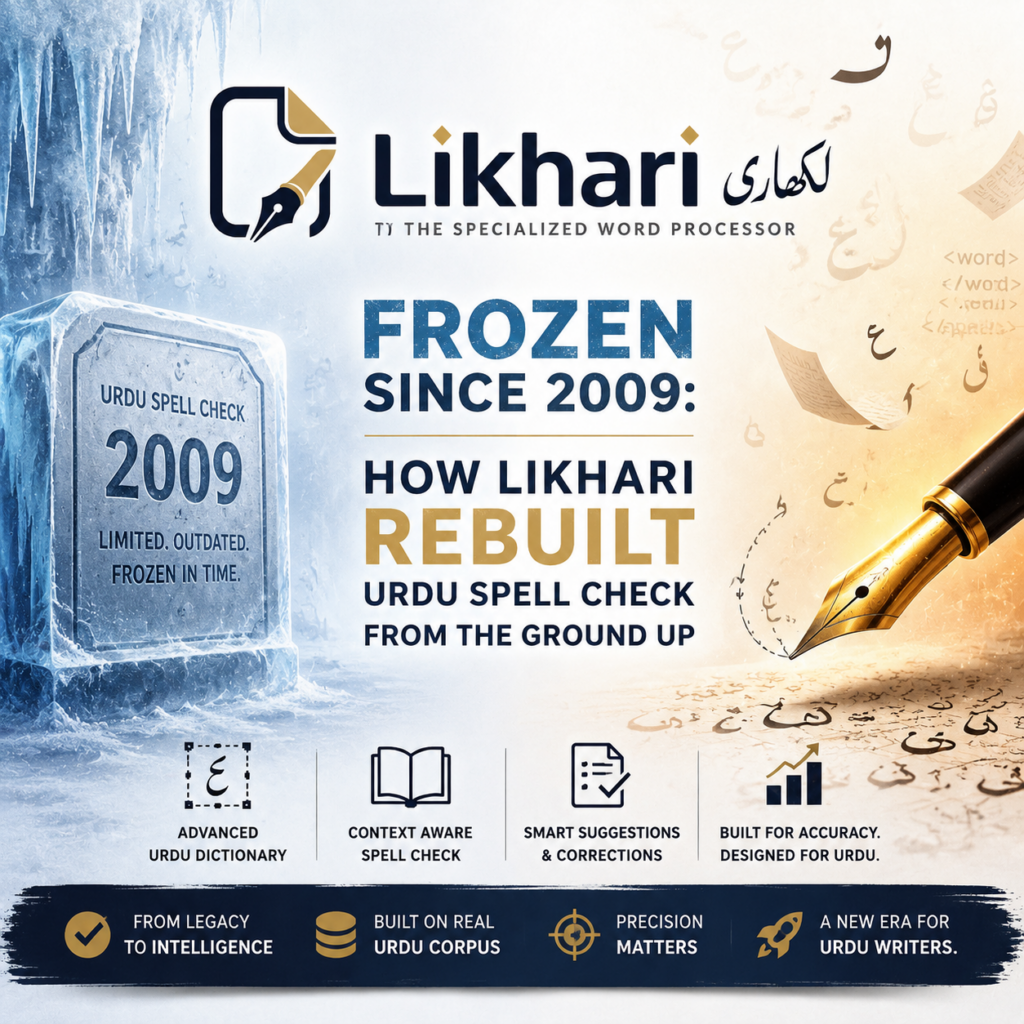
What we found was sobering. CLE/CRULP’s most substantial piece of work for exactly this problem — the kind of grammar-aware tool that could teach a spell checker how Urdu words change form — dated back to 2009, and nothing meaningfully newer had followed it. For a living, actively spoken language, a language tool frozen for over a decade and a half is effectively a dead end, not a foundation to build on.
We also pulled CLE’s own published Urdu word list to see whether it could at least fill in vocabulary gaps directly. It looked promising on paper — a large list, seemingly comprehensive. In practice, once compared word-for-word against what Likhari already had, it added almost nothing: the vast majority of its “extra” entries turned out to be whole phrases (multi-word strings like “ice cream” written as one entry) rather than individual dictionary words a spell checker can actually use. Genuinely new, usable words numbered only a couple.
That was the real finding: there was no shortcut. The only way forward was to build a new dictionary from the ground up.
Words alone weren’t the actual problem
Before writing a single new word, we looked closely at why the checker was failing, and it wasn’t really a vocabulary gap. The old dictionary already had a very respectable 116,000+ words. The real problem was that it was a flat list with no grammar behind it — every word had to be spelled out individually, plural forms included, or the checker had no way of knowing they were valid. That is the equivalent of an English spell checker that knows “book” but has never been told that “books” exists.
Likhari — Nastaliq Word Processor for Urdu, Pashto, Arabic & Sindhi
Likhari ships this rebuilt Urdu spell check as part of version 2.6 and later — free, entirely offline, and running alongside spell check for Arabic and Persian too, with per-selection and per-style language tagging for documents that mix scripts. Free to use, with a one-time Pro unlock that removes the small export watermark.
What we actually built
Rather than just typing in thousands more individual words by hand — which doesn’t scale and never really finishes — we taught the checker Urdu’s own grammar. The new dictionary carries 25 grammar rules covering how Urdu nouns change shape: the ordinary masculine plural, the feminine plural, the possessive/oblique form used before postpositions, and the Arabic-style plural pattern borrowed into Urdu for words of Arabic origin.
Applying those 25 rules to the existing word list taught the checker correct plural and inflected forms for roughly 9,800 root words it already knew — about 15,500 additional recognised word-forms in total, without anyone having to type each one in by hand. In practical terms, over 1,300 genuinely correct Urdu words that used to get flagged as typos — including that opening example, “کتابیں” — are now recognised properly.
On top of the grammar work, we added:
- 224 modern, everyday words that simply weren’t in any Urdu word list we could find — practical vocabulary like “ایپ” (app), “ڈرون” (drone), and place names such as “پختونخوا” that ordinary users actually type.
- Correct recognition of about 30 compound words written with the invisible joining mark used in words like “صورتحال” (situation) and “دہشتگردی” (terrorism) — previously split apart and flagged as two separate misspellings.
- Over 1,200 explicitly flagged common mistakes — real, frequently-made Urdu typing errors that the checker now catches and corrects rather than silently missing.
Trust, not guesswork
The part we were most careful about: none of this was accepted on faith. Every single new grammar-generated word-form — close to 12,800 of them — was checked against real, everyday Urdu writing before being trusted. If a rule produced a form that didn’t actually occur in genuine Urdu usage, it didn’t make it into the dictionary. That discipline is also why the new dictionary doesn’t just add words — it does so without starting to accept genuine misspellings, which is the opposite failure and arguably the worse one.
We measured the real-world effect on an actual Urdu document, not just a lab test: the false-flag rate dropped, and — just as important — not a single word the old checker got right became newly wrong under the new rules.
Key takeaways
- A “known root word, unrecognised plural” pattern is usually a sign of a flat word list with no grammar behind it — not a vocabulary problem.
- The most authoritative-looking language resource isn’t always still alive. CLE/CRULP’s flagship Urdu language tooling stalled around 2009; treat that as a warning sign to verify currency, not assume authority equals recency.
- Teaching grammar rules, not just adding words, is what actually scales — 25 rules taught the checker correct forms for nearly 9,800 root words at once.
- New vocabulary and new grammar rules both need real-world validation before shipping, or you risk trading missed words for accepted misspellings.
Likhari — Nastaliq Word Processor for Urdu, Pashto, Arabic & Sindhi
Likhari ships this rebuilt Urdu spell check as part of version 2.6 and later — free, entirely offline, and running alongside spell check for Arabic and Persian too, with per-selection and per-style language tagging for documents that mix scripts. Free to use, with a one-time Pro unlock that removes the small export watermark.
Leave a Reply