Software projects often begin with a clear goal, but sometimes they evolve into something much bigger than originally imagined.
Likhari is one such story.
It was never planned to become a standalone Urdu word processor.
The journey started with a different challenge: how to render beautiful Urdu Nastaleeq typography correctly inside PublishingDesk.
The Beginning: Solving Nastaleeq Typography
PublishingDesk was created as a publishing solution for Urdu documents. One of its biggest technical challenges was handling the complexity of Nastaleeq script.
Unlike simple Latin text rendering, Urdu Nastaleeq requires advanced shaping, positioning, and character handling. The same letter can appear in different forms depending on its position in a word, and proper Nastaleeq composition requires careful placement of characters and Kashidas (کشیدہ) to achieve the traditional calligraphic appearance.
To solve this problem, we built a dedicated Nastaleeq Kashida Engine.
The engine’s job was focused:
- Analyze Urdu text
- Understand character relationships
- Apply Nastaleeq joining rules
- Insert and adjust Kashidas
- Produce visually balanced typography suitable for professional publishing
At that stage, it was not a word processor.
It was simply a technology layer powering PublishingDesk.
The Engine Became More Capable
As development continued, the engine matured.
Better text handling led to better editing capabilities.
Better editing required document management.
Document management required formatting tools.
Formatting tools naturally required features users expect from a writing environment.
Slowly, the boundaries started changing.
What began as a typography engine started gaining:
- Urdu text editing
- Paragraph formatting
- Character styling
- Document handling
- Page layout support
- Writing tools
The foundation was no longer just a rendering engine.
It had become the core of a complete Urdu writing experience.
The Birth of Likhari
At some point, it became clear that this technology deserved its own identity.
The Nastaleeq engine was no longer just a component inside another application.
It had evolved into something much bigger:
A dedicated Urdu word processor built from the ground up.
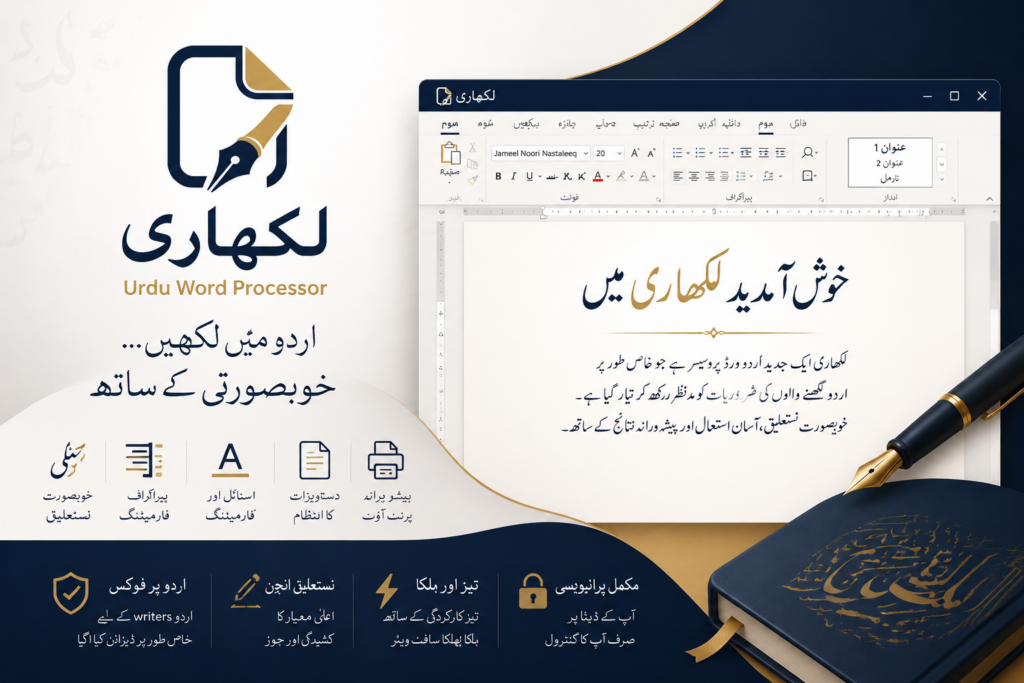
That product became Likhari (لکھاری).
The name itself represents the idea behind the software — a writer, a person who creates and preserves ideas through words.
Likhari was built with a simple vision:
Urdu writers should have a modern writing tool designed specifically for their language.
Not a translated interface.
Not a workaround.
A native Urdu writing environment.
Built Around Urdu From Day One
Many word processors treat Urdu as an additional language feature.
Likhari takes the opposite approach.
Urdu is not an extra capability — it is the foundation.
The software is designed around the realities of Urdu writing:
- Nastaleeq typography
- Right-to-left text flow
- Urdu paragraph formatting
- Professional document creation
- Publishing-quality output
The same technology that started as a publishing component became the foundation for everyday writing.
A Lesson From Software Development
The story of Likhari is also a reminder that great software is not always planned in a single step.
Sometimes the best products emerge from solving a difficult technical problem deeply.
A typography challenge became a text engine.
A text engine became an editor.
An editor became a complete application.
Today, Likhari stands as the result of that evolution:
A word processor born from a Nastaleeq engine, created for Urdu writers.
Likhari — from powering Urdu publishing to empowering Urdu writing.
Leave a Reply