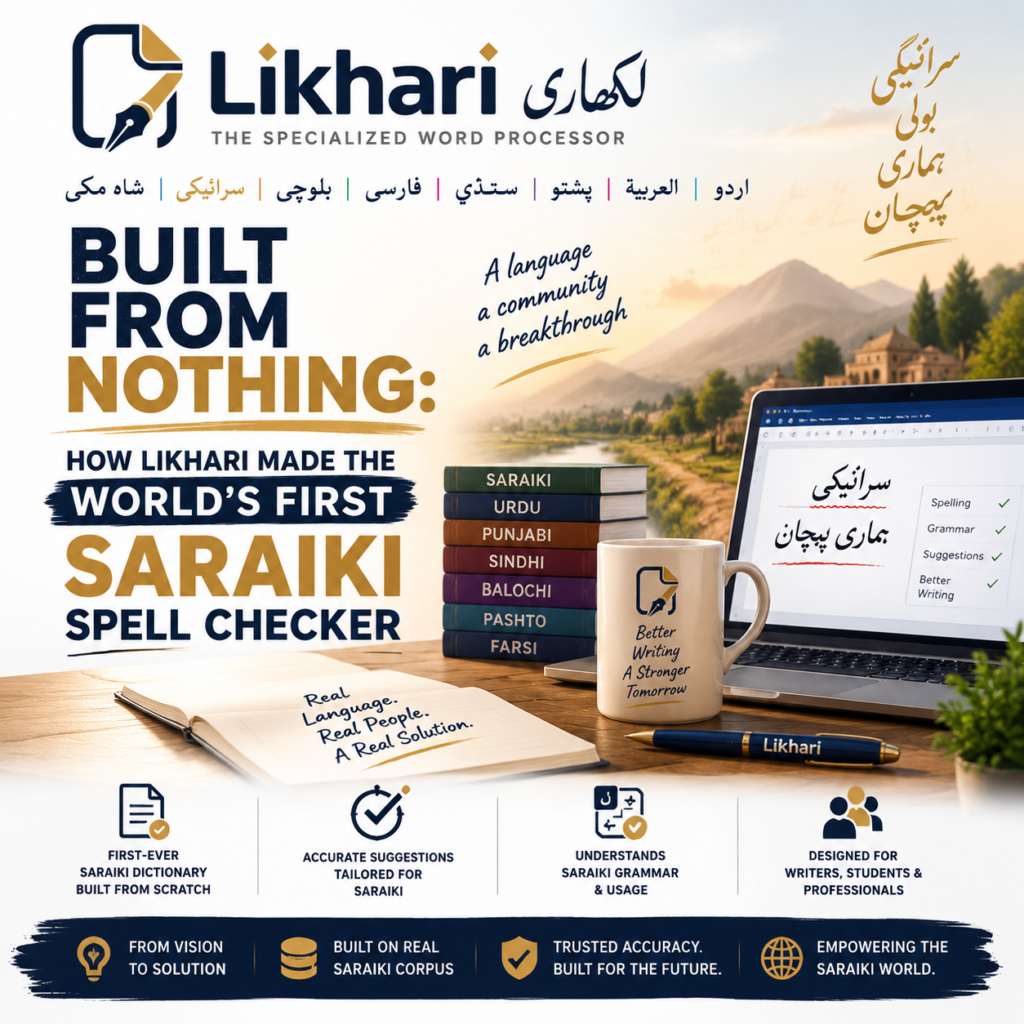
Type a sentence in Saraiki into almost any writing tool today and you’ll get the same result: nothing. Not “few suggestions,” not “limited support” — nothing. As far as we could verify, checking every place a language’s spell-check dictionary would normally show up, no Saraiki spell checker existed anywhere, for any program, ever. That is not a small gap. Saraiki is spoken by tens of millions of people, mostly across southern Punjab in Pakistan, with its own distinct script, its own grammar, and its own identity separate from Urdu. It had simply never had this basic tool built for it. So we built it.
Hurdle one: there was nothing to start from
Every other language Likhari supports had something to build on — an old word list, a partial project, even an abandoned one. Saraiki had none of that. No existing dictionary, no lexicon, no prior attempt anywhere we could find. The only real, authentic Saraiki text available in any quantity was ordinary, everyday writing already out in the world. Every single word in the new dictionary had to be earned from that — nothing was assumed, and nothing was invented.
Hurdle two: the biggest risk wasn’t missing words, it was erasing the language itself
Saraiki is written in a script closely related to Urdu’s, but with a handful of extra letters Urdu simply doesn’t have — sounds that don’t exist in Urdu at all. Those letters are exactly what make Saraiki its own language rather than a regional way of writing Urdu.
Here is the danger we ran into: because so much everyday Saraiki writing online already gets typed with Urdu spelling habits — people substituting the nearest Urdu letter for a Saraiki one they cannot easily type — a purely statistical approach looking at “what spelling is more common” would have gotten it backwards. One clear example: the correct Saraiki spelling of a very ordinary word showed up only 406 times in real writing, while the Urdu-style misspelling of that exact same word showed up over 12,000 times. Judged by popularity alone, the tool would have confidently “corrected” the real Saraiki word into the wrong one — training an entire generation of writers to spell their own language more like Urdu, one red squiggly underline at a time.
We caught this before it shipped and explicitly protected Saraiki’s distinctive letters from ever being “corrected” away, regardless of how the raw numbers looked. It is a reminder that building a spell checker for a language is not just counting — it takes someone paying attention to what the numbers actually mean.
Likhari — Nastaliq Word Processor for Urdu, Pashto, Arabic & Sindhi
Likhari already types real Saraiki today — a dedicated positional keyboard layout, true script rendering, and full document tools — with spell check for Urdu, Arabic and Persian live now, and Saraiki on the way. Free to use, with a one-time Pro unlock that removes the small export watermark. Works fully offline.
Hurdle three: a pronunciation mark unique to Saraiki, initially destroyed by mistake
Saraiki has its own way of marking a nasal sound in writing — a small mark that simply does not exist in Urdu, Arabic or Persian. Because the tools built for those other languages had never needed to handle it, early testing mishandled it too, and thousands of perfectly correctly spelled Saraiki words got wrongly flagged as foreign-looking gibberish. The error rate on real text was measured at a startling 9.67% — until the mark was properly recognised, at which point the true error rate dropped to 0.05%. The overall real-world flag rate on unfamiliar text fell right along with it, from over 12% down to about 2.5%. One overlooked detail was responsible for the vast majority of what looked, at first, like a fundamentally broken dictionary.
What actually got built
The finished dictionary holds 33,974 words, taught 24 grammar rules covering how Saraiki nouns and verbs change form — plurals, verb endings, derived words — every single one of them verified against real, everyday Saraiki writing before being trusted, not assumed from a textbook. Applying those rules taught the checker correct grammatical forms for roughly 11,300 root words, adding about 22,300 additional recognised word-forms on top of the base list.
Tested against real, unfamiliar Saraiki text it had never seen before, the checker now flags only about 4.6% of words — and measurement showed that almost all of what is left is proper names: people’s names, place names, foreign words. No dictionary, in any language, is expected to know those. The unavoidable floor for this kind of test measured at roughly 2.5%, meaning the checker is already operating close to as well as any dictionary reasonably could.
Where it stands today
The dictionary is built, tested, and verified — the first Saraiki spell checker we can find any evidence of, anywhere. What’s next is bringing it fully into Likhari itself, the way Urdu, Arabic and Persian spell check already work today. Saraiki already has a full typing keyboard layout in Likhari; a Saraiki spell checker riding alongside it is the natural next step, and it is coming.
Key takeaways
- No Saraiki spell checker existed before this one — for any app, on any platform, as far as could be verified.
- Popularity in everyday writing is not the same as correctness — a purely statistical approach would have “corrected” Saraiki’s own distinctive letters into Urdu ones, actively eroding the language it was meant to serve.
- A single overlooked detail — one pronunciation mark unique to Saraiki — was responsible for the overwhelming majority of an initially alarming error rate.
- 24 grammar rules taught the checker correct forms for over 11,000 root words, and the whole thing was verified against real writing rather than shipped on faith.
- Built and tested; full integration into Likhari’s spell checker is the next step.
Likhari — Nastaliq Word Processor for Urdu, Pashto, Arabic & Sindhi
Likhari already types real Saraiki today — a dedicated positional keyboard layout, true script rendering, and full document tools — with spell check for Urdu, Arabic and Persian live now, and Saraiki on the way. Free to use, with a one-time Pro unlock that removes the small export watermark. Works fully offline.
Leave a Reply