Font folders sprawl. There is the set that came with the machine, the ones a design bundle installed, a folder of freebies from three years ago, whatever a client sent as a zip, and the two hundred faces you downloaded meaning to look at properly one day. Windows will show you a flat alphabetical list of what is installed and nothing at all about what is merely sitting on disk — and Font Book-style double-click-to-install leaves you with a system font list you can no longer navigate and cannot safely prune.
FontDesk is a font manager for Windows built to fix that: see what you actually have, judge it properly, keep it organised, and install — or uninstall — without the process being a one-way door. It is on the Microsoft Store now, with a free trial.
Read a folder without installing anything
Press Add Library and choose a folder, or just drop one on the window. FontDesk reads every font inside it and in every subfolder — and that is all it does. Nothing is installed, nothing is copied, nothing is moved. The files stay exactly where they are; FontDesk keeps only what it learned about them.
This is the part that changes how you work. A folder of a hundred candidate fonts becomes browsable, searchable and comparable before anything touches your system. You audition the set, install the three you chose, and the other ninety-seven never entered your font list at all.
It reads TrueType, OpenType, TrueType/OpenType collections, WOFF and WOFF2. A face inside a collection file is treated as a font in its own right — previewed, tagged and installed separately from its neighbours in the same file, rather than lumped together as one entry the way most tools handle collections.
Previews that tell the truth
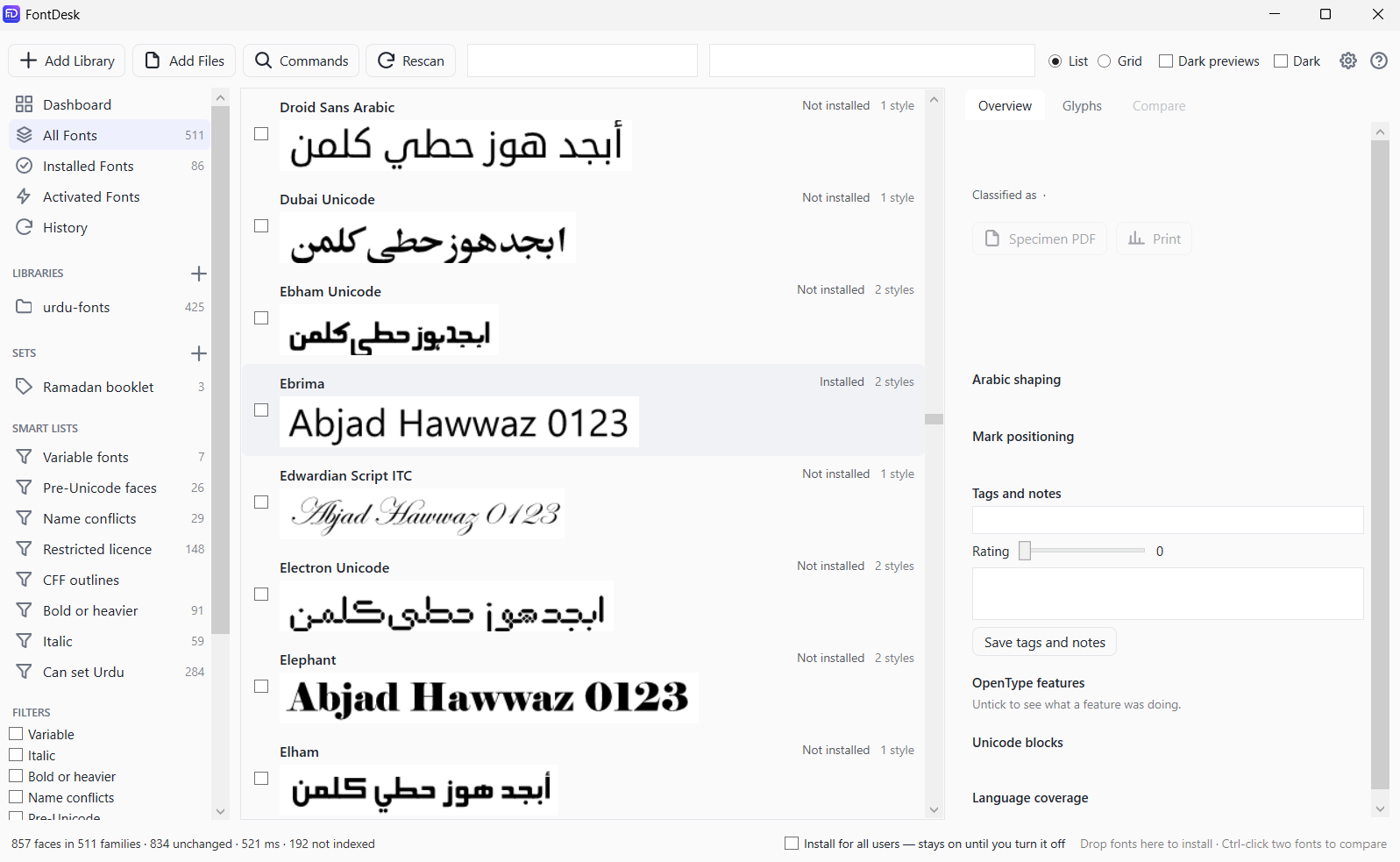
Every font in the list is shown a sample it can actually render, chosen from its own coverage rather than from its name. A text face gets a phrase; a display face gets something that shows off what it is for; a font whose coverage is elsewhere gets text from that script instead of a row of empty boxes.
Type your own string into the preview box and every font sets it — your headline, your client’s name, whatever you are actually going to typeset. A font that cannot render your string falls back to its own sample and says cannot set your text beside it, so you keep a useful screen and learn which fonts fail at the same time.
One rule underpins all of it: FontDesk never substitutes another font’s glyphs. Every rendering engine on your machine will quietly borrow a missing character from some other font, which is exactly why broken fonts survive a preview and then fail in the document. If FontDesk drew a specimen, that font drew it. A preview that looks right is a font that is right.
Judge a face properly
Select a font and the detail pane gives you the things you would otherwise open three tools to see:
- A size ladder, so you can see where a face stops working — the hairline that vanishes at 9pt, the display cut that only holds together above 40.
- A complete glyph map: coverage by Unicode block, or one block’s glyphs with their ids, advances, sidebearings and the OpenType features that touch them.
- An OpenType feature playground. Type a string, then untick
liga,calt,ss01or anything else the font carries and watch what changes. It is the fastest way to find out what you are actually buying in a font that advertises “30 stylistic alternates”. - A specimen per script the face covers, so a font that claims broad support has to show it.
Ctrl-click a second font and the Compare tab lights up: an onion-skin overlay normalised by cap height rather than by nominal point size. That distinction matters more than it sounds. Two faces set at 24pt can differ wildly in apparent size, because point size is a nominal measure and every foundry draws to its own em. Normalising by cap height compares the letters as the reader will see them, which is the only comparison worth making. You also get their metrics side by side as em fractions, which codepoints one has and the other lacks, and their OpenType feature differences.
FontDesk will also find similar fonts in your own library, and suggest headline and body pairings — from what you already own, not from a catalogue you would have to go and buy.
FontDesk — Font Manager for Windows
FontDesk reads a folder of fonts without installing anything, previews every face truthfully, and gives you a glyph map, an OpenType feature playground and a proper side-by-side comparison. Organise with sets, smart lists, tags and ratings; install for yourself with no administrator prompt, for everyone with a single one, or activate a font for one session and leave nothing behind — with an undo history that really does put a removed font back. Works entirely offline: no account, no telemetry. On the Microsoft Store now, with a free trial.
Find out what your collection actually is
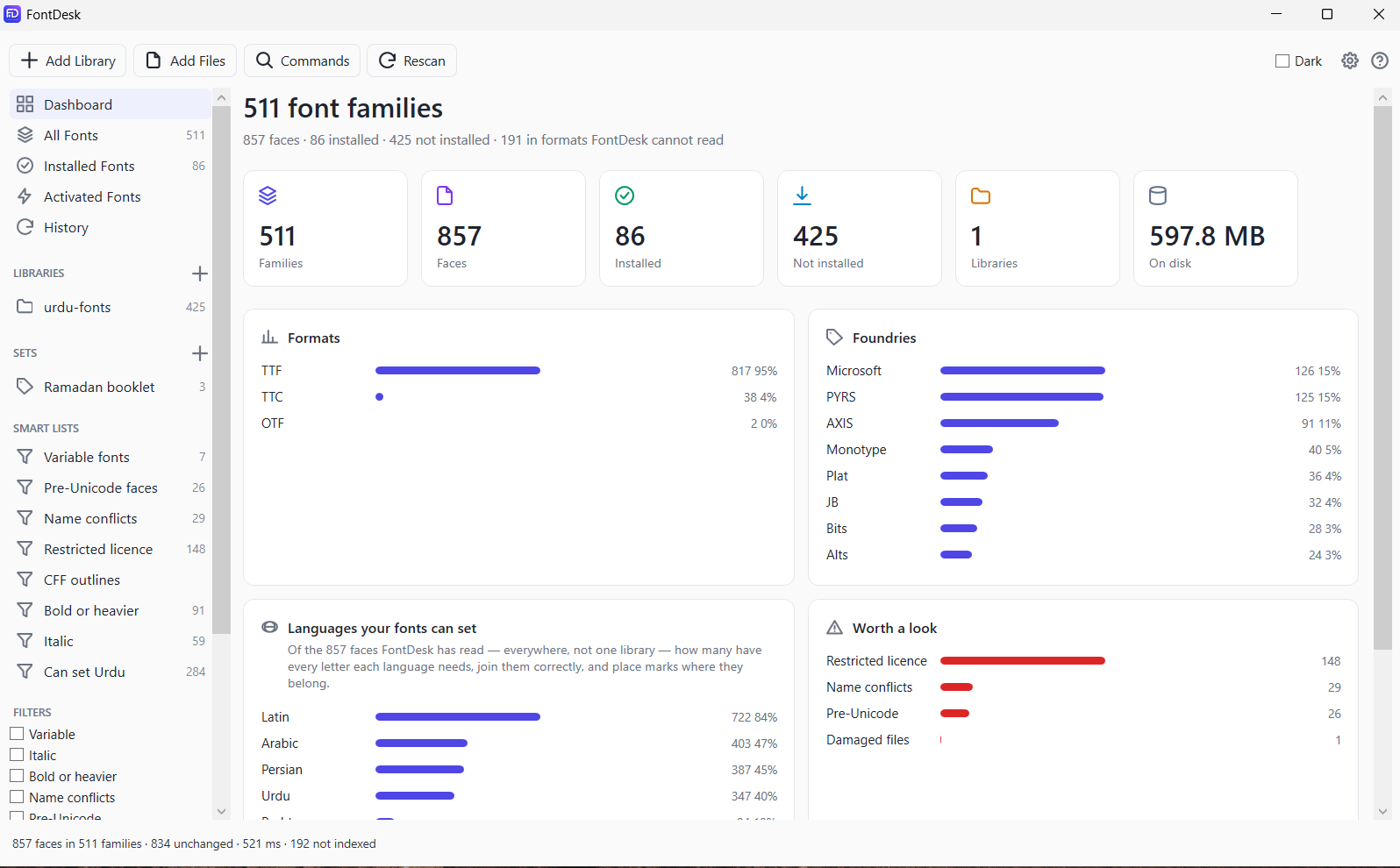
The dashboard answers the question you cannot answer today: what is this collection? How many families and how many faces. How much of it Windows already has, and how much is sitting on disk unused. What it weighs. Which formats it is made of, and which foundries it came from.
Then Worth a look — the panel that saves you from yourself. Restricted licences, so you find out a face is not embeddable before it goes into a client PDF rather than after. Name conflicts, where two files claim the same family and whichever loaded last wins. Damaged files that could not be read at all. And pre-Unicode faces, which we will come back to.
Organising: sets, smart lists, and tags that survive
- Sets you assemble by hand — and activate or deactivate as a whole. That is the point of them: one gesture puts a project’s typefaces on the desktop, another takes them away when the project ships.
- Smart lists that keep themselves current: variable fonts, bold or heavier, italics, restricted licences, name conflicts — standing questions rather than folders you have to maintain.
- Tags, ratings, colours and notes, keyed to the font’s own content rather than to its file path. Move the file, rename it, or reinstall it from somewhere else entirely and your notes are still attached. Anyone who has lost a carefully tagged library to a folder reorganisation knows why this matters.
- Faceted filters on weight, width, italic, variable axes, licence, foundry and format.
- Paste any text into the sidebar filter and see only the fonts that can render every character of it — a product name with an accented letter, a price with a currency symbol, a heading with an em dash and curly quotes.
- Search matches metadata — family, full name, PostScript name, foundry — not filenames, because filenames are where font metadata goes to die.
Installing, and the way back
FontDesk offers only the actions that mean something for the font in front of you:
| The font is | What you get |
|---|---|
| Not installed | Install for me · Install for everyone… |
| Installed for you | Promote to all users… · Uninstall this font |
| Installed for all | Uninstall for all users… |
Install for me registers a font for your own Windows account with no administrator prompt — most applications see it immediately. (Adobe applications have historically ignored per-user fonts, so if you live in Creative Cloud, install for everyone instead.) Install for everyone puts it in the system font folder with a single prompt, and the status-bar tick stays on until you turn it off, so a batch of two hundred raises one prompt rather than two hundred.
Temporary activation
Activate for this session makes a font available to every application on the desktop until you close FontDesk. Nothing is copied, nothing is written to the registry, and there is nothing to uninstall afterwards.
This is the answer to “I need this face for one document” — the situation that has quietly filled everyone’s font list with fonts they used once, three years ago, and can no longer identify. Activation is a loan, not an install; everything is released when FontDesk closes.
Undo that actually undoes
History lists everything FontDesk has installed or removed, newest first, one line per thing you did. A batch of two hundred is one line, and it undoes in one click.
The detail that makes it real: uninstalling keeps a copy of the font first. Undo genuinely puts the file back, rather than un-registering something that is no longer on disk to restore. And if a copy could not be kept, the status line says so at the time — before you go looking for an undo that is not there.
Safe uninstall refuses to remove the faces Windows draws its own interface with — Segoe UI, Arial, Tahoma and the rest — and tells you which and why, instead of greying out a button and leaving you to guess. Pruning a font list should not be able to break your desktop.
Where it goes deeper than other font managers
Most font managers treat a font as either present or absent. FontDesk asks a harder question, and it is the reason it exists: can this font actually set the language you are working in?
For Latin that is usually a simple matter of accented characters — and FontDesk will tell you which ones are missing. For cursive scripts it is a much bigger question, and one nothing else on Windows answers. Arabic-script languages — Urdu, Persian, Pashto, Sindhi, Kashmiri, Saraiki, Uyghur, Sorani Kurdish — each add their own letters on top of a shared core, so a font can honestly advertise Arabic support and still be unusable. And having the letters is only the first test: the script is cursive, so every letter takes a different shape depending on its position in the word, and a font can contain every character and still lack the rules that join them.
So FontDesk checks three things, per language: coverage (does it have every letter, and if not, which ones are missing — named, not expressed as a percentage), joining (every letter shaped isolated, initial, medial and final), and mark positioning (unattached and colliding marks, counted against real pairs). Previews are shaped with a real complex-script engine, so a cursive face joins and reads on screen the way it will in the document.
It also flags pre-Unicode faces — older fonts whose codepoints carry no Unicode meaning at all — and says so, rather than showing empty boxes and leaving you to work out whether the font or the text is at fault. If you have inherited an old font library of any kind, some of it is probably this.
You may never need any of it. But it is the same machinery that tells you a Latin face is quietly missing Å or Œ, and it is why FontDesk can promise that a preview which looks fine is a font that is fine.
Making things
- Specimen PDFs as real vector text — the family, a size ladder set in the font itself, and what FontDesk knows about it. A4 or US Letter, printing at any size, because it is type rather than a picture of type. Print the same sheet directly if you prefer paper.
- Backup and restore of your libraries, sets, tags, ratings and notes. Restoring merges rather than replaces, so work done since the backup survives it. The font index deliberately is not in the backup — a scan rebuilds it, and including it would multiply the file size to preserve nothing.
- Ctrl+K opens a command palette reaching every command and destination by subsequence match —
adlibfinds Add library. Ctrl+F focuses search, F5 rescans. - Light and dark chrome. Dark is a neutral grey rather than black or navy, deliberately, so the only colour on screen is the type you are judging.
FontDesk works entirely offline. No account, no telemetry, and no network connections of any kind. Everything it keeps lives under %LOCALAPPDATA%FontDesk.
What it does not do yet
An honest list, because you will find these anyway:
- Type 1 (
.pfb,.pfm) and legacy.FONbitmap fonts are recognised and listed but not read. FontDesk reports them as unsupported rather than damaged, because that is what they are. - Auto-activation per project — activating a document’s fonts when you open it — is deferred. The mechanism exists; Windows offers no reliable signal that a document was opened.
- Activated Fonts does not survive a restart, by design.
- The dashboard’s language counts mean has every letter. Whether a font joins them is a separate, slower analysis that runs for the font you have selected.
Key takeaways
- Add a folder as a library and browse every font in it — nothing installed, nothing copied, nothing moved.
- Previews are truthful: each font sets text it can actually render, and no glyph is ever borrowed from another face.
- Size ladders, a full glyph map and an OpenType feature playground for the selected font, plus a comparison overlay normalised by cap height rather than point size.
- A dashboard that finds restricted licences, name conflicts and damaged files before they find you.
- Sets, smart lists, tags and ratings keyed to the font itself, so they survive a move or a rename.
- Install for yourself with no administrator prompt, for everyone with a single one, or activate temporarily and leave nothing behind.
- Every install and removal is reversible — uninstalling keeps a copy first, so undo really does put the font back.
- The deepest script analysis of any font manager on Windows: per-language coverage, joining and mark positioning, for Latin and eight Arabic-script languages.
- Entirely offline: no account, no telemetry, nothing sent anywhere.
FontDesk 1.0 is on the Microsoft Store now, with a free trial. If your font situation is a folder you have been meaning to sort out for two years, start there.
FontDesk — Font Manager for Windows
FontDesk reads a folder of fonts without installing anything, previews every face truthfully, and gives you a glyph map, an OpenType feature playground and a proper side-by-side comparison. Organise with sets, smart lists, tags and ratings; install for yourself with no administrator prompt, for everyone with a single one, or activate a font for one session and leave nothing behind — with an undo history that really does put a removed font back. Works entirely offline: no account, no telemetry. On the Microsoft Store now, with a free trial.
Leave a Reply