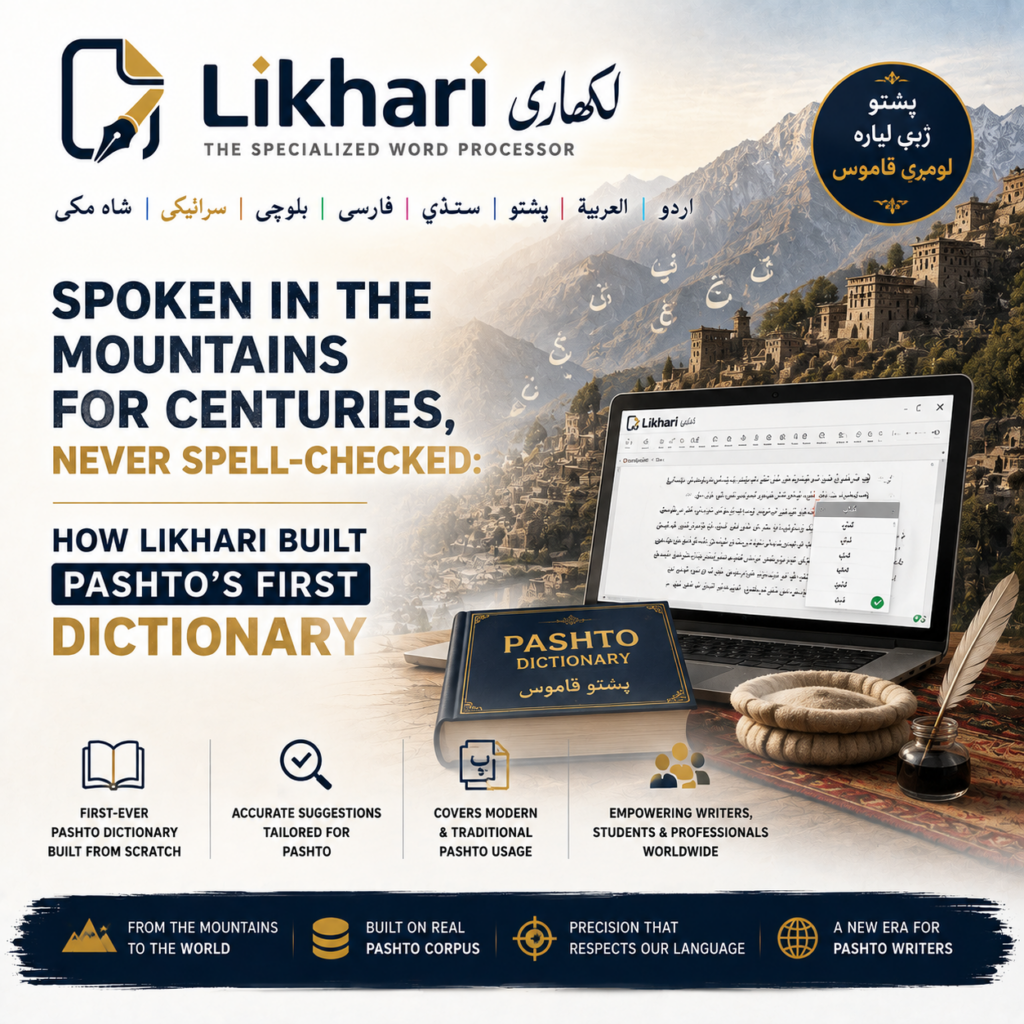
Pashto has been spoken in the mountains and cities around Kabul, Kandahar, Peshawar and Quetta for well over a thousand years — one of the major living languages of Afghanistan and Pakistan, carried by tens of millions of speakers and a long tradition of poetry and prose. And yet, as far as we could verify, checking every place a spell-check dictionary for a language would normally exist, no Pashto spell checker had ever been built. Not a small one, not an old abandoned one — none at all. This is the story of building the first.
Hurdle one: starting from nothing, again
Pashto had no existing dictionary or word list to build from — nothing to improve, only real Pashto writing itself to learn from. But Pashto is a much bigger language online than some of the others in this project, and that turned out to matter: the sheer amount of real, everyday Pashto writing available to check against was several times larger, giving this dictionary a far bigger foundation of genuine, real-world usage to stand on.
Hurdle two: letters that look almost the same but are never interchangeable
Pashto’s script adds several letters and sounds Urdu, Arabic and Persian don’t have — and among them is a small family of letters that all sound roughly like “y” or “e” to an outsider’s ear, but are never interchangeable to a Pashto reader. Two words that look almost identical, differing by only one of these letters, can be completely different words. One pair alone showed up 6,745 times written one way and 247,037 times written the other — both spellings correct, both real, both common, just two different words entirely. Treating them as the “same letter, different spelling” would have meant confidently telling people their correct word was wrong roughly one time in forty. Every one of these letters had to be checked on its own evidence rather than assumed.
Likhari — Nastaliq Word Processor for Urdu, Pashto, Arabic & Sindhi
Likhari has rendered true Nastaliq for Pashto since its earliest versions — alongside Urdu, Arabic and Sindhi — with a dedicated Pashto keyboard layout and full document tools. Spell check for Urdu, Arabic and Persian is live now, with Pashto on the way. Free to use, with a one-time Pro unlock that removes the small export watermark. Works fully offline.
Hurdle three: the most common word in the language was quietly being deleted
This is the one worth telling in full, because it is the kind of mistake that hides in plain sight. Early in the build, a general-purpose rule aimed at filtering out junk and noise — the digital equivalent of “throw out anything too short to be a real word” — was applied the same way it had been for other languages. For Pashto, that rule quietly deleted the single most common word in the entire language: a one-letter word meaning “of,” used well over a million times in ordinary writing. Once it was gone from the dictionary, the checker began flagging it as wrong every single time it appeared — which, for the most common word in the language, is constantly.
The result was a spell checker that looked badly broken: it was wrongly flagging nearly 1 in 7 words in real Pashto text. The fix, once found, was simple: short, extremely common words needed their own, much more forgiving rule than rare ones. After the fix, the error rate on the same real text fell to well under 5%. One overlooked line was responsible for almost the entire gap.
Hurdle four: words quietly glued together
Pashto speakers very commonly type two short, extremely common words — “of” and “and” — running directly into the next word with no space between them, the way a fast typist runs “andthen” together in English. Left alone, that habit would have taught the checker to accept the error as normal. Instead, over 2,500 of these specific run-together mistakes were identified from real writing and explicitly taught to the checker as wrong — and, more usefully, taught to suggest the correct, properly spaced version instead of just underlining it in red.
What actually got built
The finished dictionary holds 67,554 words, taught 24 grammar rules covering how Pashto nouns, verbs and adjectives change form — masculine and animate plurals, verb formation, Arabic-style plurals borrowed into the language, and more — every one of them checked against real Pashto writing before being trusted. Applying those rules taught the checker correct grammatical forms for close to 19,000 root words, adding over 32,500 additional recognised word-forms.
Tested against two entirely different kinds of real, unfamiliar Pashto writing — professionally translated news text and genuinely native-authored news writing — the checker landed at almost exactly the same result both times: just under 5% of words flagged. That consistency matters: it means the dictionary performs the same on real, natural Pashto as it does on more polished, edited text, rather than being tuned to do well on one and poorly on the other. And, as with every other language in this project, what is left flagged is overwhelmingly proper names and foreign words — not real Pashto being marked wrong.
An honest, open question
One thing was deliberately left unresolved rather than quietly decided: Pashto, like many living languages with a long history and wide geography, has more than one accepted way of writing certain words depending on region and publisher — not a mistake, just a difference in house style. Measurement showed this genuinely only affects one narrow style of writing, and even there it accounts for a small slice of the overall picture. Rather than silently pick a side on what is really a question of identity and convention, that choice has been left open, flagged clearly for a native Pashto speaker to weigh in on, instead of being buried inside a technical decision nobody would think to question.
Where it stands today
The dictionary is built, tested against two independent samples of real Pashto writing, and — as far as we could verify — the first spell checker ever built for the language. Pashto already types beautifully in Likhari today, with true Nastaliq rendering and its own keyboard layout, alongside Urdu, Arabic and Sindhi from the very start. Spell check is the one piece still missing, and bringing this dictionary into the app itself is the natural next step.
Key takeaways
- No Pashto spell checker existed before this one, for any language spoken by tens of millions of people, in any app, anywhere.
- Letters that look interchangeable to an outsider can mark completely different words — one pair alone appeared in both forms hundreds of thousands of times, both correct.
- A single overly broad filtering rule nearly broke the entire dictionary by deleting the most common word in the language — a reminder that assumptions from one language do not automatically hold in another.
- Real typing habits, like two common words run together, were taught to the checker directly from thousands of real examples rather than guessed at.
- Genuine open questions about regional spelling conventions were left open for a native speaker, not quietly decided by a machine.
- Built and tested; bringing it into Likhari itself is the next step.
Likhari — Nastaliq Word Processor for Urdu, Pashto, Arabic & Sindhi
Likhari has rendered true Nastaliq for Pashto since its earliest versions — alongside Urdu, Arabic and Sindhi — with a dedicated Pashto keyboard layout and full document tools. Spell check for Urdu, Arabic and Persian is live now, with Pashto on the way. Free to use, with a one-time Pro unlock that removes the small export watermark. Works fully offline.
Leave a Reply