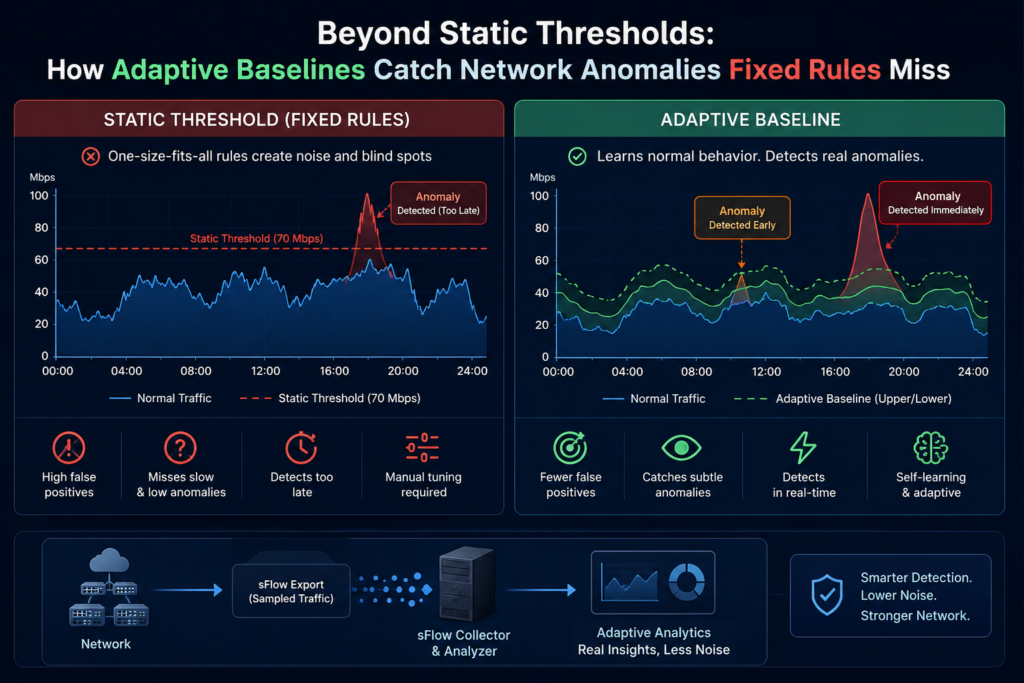
Ask anyone who runs a network monitoring system what they hate most, and you’ll hear the same two complaints: “it alerts on everything” and “it missed the thing that actually mattered.” Both come from the same root cause—static thresholds. Pick a number for “too much traffic,” and it’s wrong the moment your network changes. Adaptive baseline anomaly detection solves this by learning what normal looks like for your network and alerting on genuine deviations. Here’s how it works and why it’s a fundamentally better approach.
Why static thresholds fail
A fixed threshold assumes your network has one “normal.” It doesn’t. Traffic at 3 a.m. Sunday looks nothing like 10 a.m. Monday. A backup job, a software rollout, or seasonal load all shift the picture. So you’re forced into a bad trade:
- Set the threshold low and you drown in false alarms every busy period.
- Set it high and a slow, deliberate attack—data exfiltration, a gradual ramp—slides right under it.
There is no single number that’s right. That’s the whole problem.
What an adaptive baseline does differently
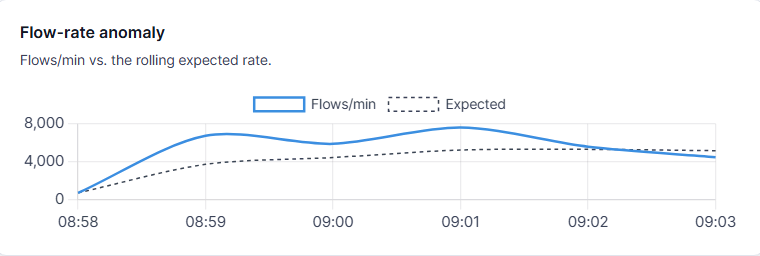
Instead of a fixed number, an adaptive baseline continuously learns your network’s own history and models what to expect—along with how much it normally varies. A spike is judged not against an arbitrary limit, but against how far outside its own normal range the traffic has moved. Two design choices make this powerful:
- It learns by time of week. Monday morning is compared to other Monday mornings, not to Saturday night. The daily and weekly rhythm of your network becomes part of the model, so routine peaks stop triggering alarms.
- It watches for both bursts and slow ramps. A fast-reacting view catches sudden spikes; a slow-reacting view catches gradual climbs that a burst detector would quietly absorb. Together they see the sudden flood and the patient exfiltration.
Learn first, alert when you’re ready
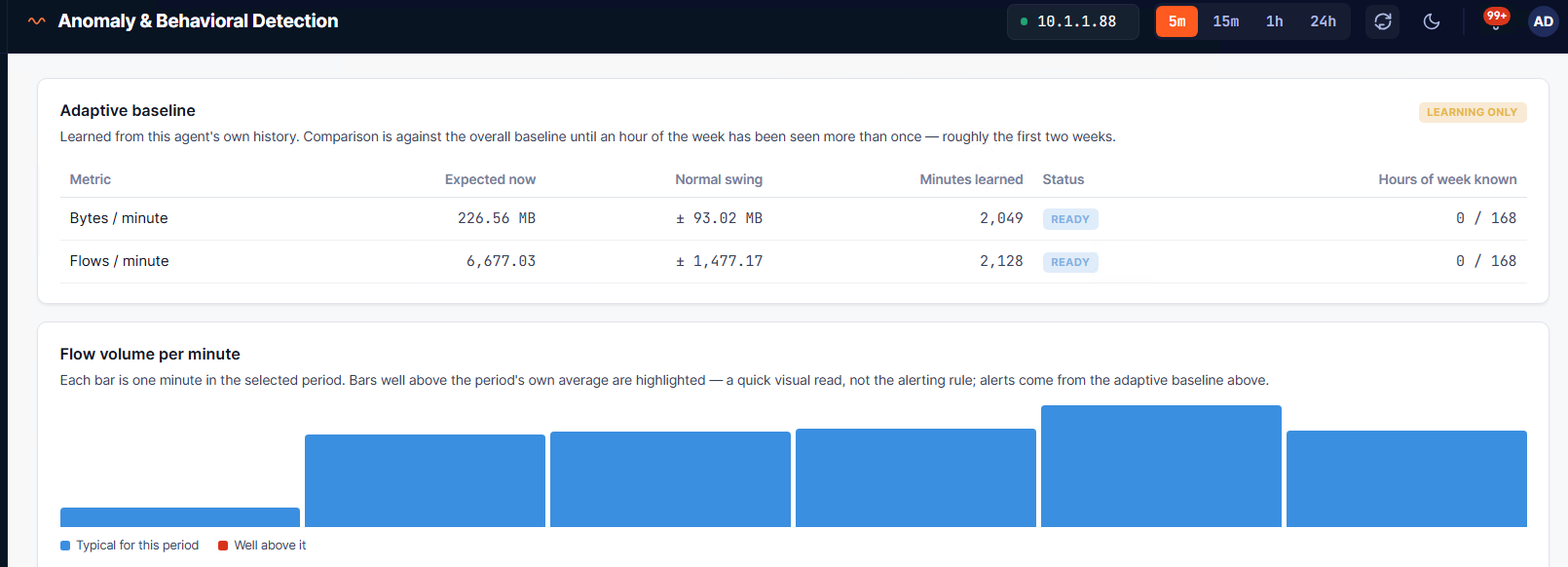
The best part of a self-learning detector is that it earns your trust before it interrupts you. A good implementation ships in a learning-only mode: it studies your traffic and records what it would have flagged, without raising a single alert. You review those findings, confirm they line up with real events, and only then switch it to raising alerts—with no cold-start penalty, because it already knows your network.
Adaptive baselines in BackendSide sFlow
BackendSide sFlow Collector & Analyzer builds this directly on your live sFlow feed. It learns per-agent traffic baselines—flows per minute and bytes per minute—organized by hour of the week, using both a fast track for bursts and a slow track for ramps. It scores each minute as deviations above the expected range, so alerts reflect real abnormality rather than an arbitrary cutoff. And it starts in learning-only mode by default, so you can watch it get smarter on the Anomaly Detection page before you ever turn on alerts. No thresholds to guess, no per-network tuning marathon—just a detector that understands your network.
BackendSide sFlow Collector & Analyzer — Anomaly Detection That Learns Your Network
BackendSide sFlow Collector & Analyzer builds adaptive baselines directly on your live sFlow feed — per-agent flows-per-minute and bytes-per-minute, organized by hour of the week, with a fast track for bursts and a slow track for ramps. It scores each minute against its own expected range instead of an arbitrary cutoff, and starts in learning-only mode so you can watch it get smarter before you ever turn on alerts. No thresholds to guess, no per-network tuning marathon.
The bottom line
Static thresholds ask you to predict the future with a single number—and punish you when you’re wrong. Adaptive baselines ask your network to describe itself, then watch for the moments it stops behaving like itself. That’s how you cut false alarms and catch the subtle attacks at the same time. It’s not a tweak to threshold-based monitoring; it’s a better foundation for it.
Leave a Reply